
The Injury Doesn't Appear the Day It Hurts: It Was in Your Data for Weeks
 Ricardo Marco
For years, whenever a runner came into the clinic with an injury, the first question was always the same: What did you do that day? And there was almost always an answer: track intervals, a long run, a technical downhill. Today I know that question was flawed. A running injury rarely appears the day it hurts: it usually spends weeks warning you in training data, sleep, and how the body feels—only nobody was looking in the right place.
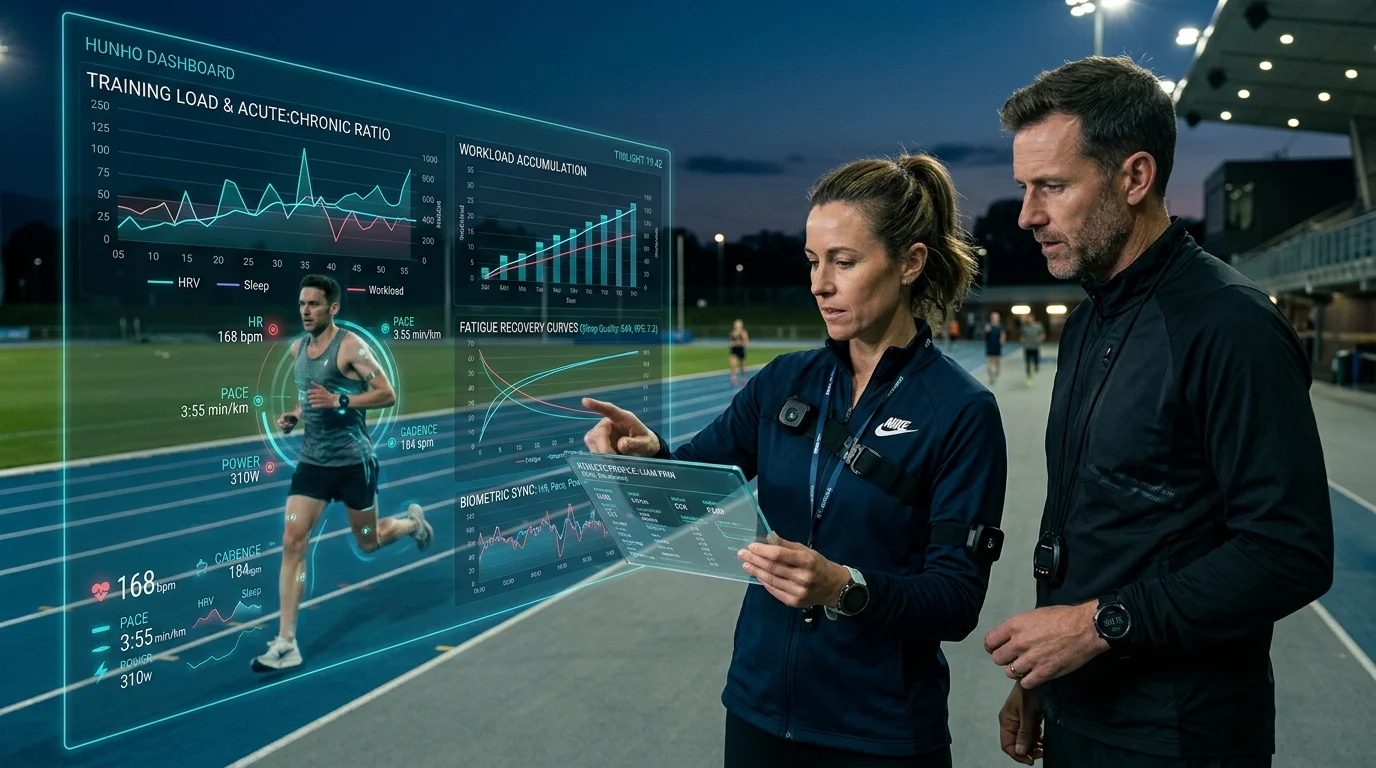
An injury is not an event: it is a process
When we talk about running overuse injuries (tendinopathies, patellofemoral pain, shin splints, stress fractures), we usually talk about them as if they were accidents. One day everything is fine, and the next day you can’t run. But biological tissue doesn’t work that way.
Most runner injuries occur when accumulated workload exceeds, over time, the tissue’s capacity to adapt. It is an imbalance that brews gradually: a week with higher mileage, a few nights of poor sleep, legs that never quite recover. None of those factors, taken in isolation, seems serious. Sustained together, they certainly are.
That is why the day pain appears is not the beginning of the problem. It is simply the day the problem becomes impossible to ignore.
If you are a coach, this reframes the question entirely. It is no longer what did they do that day?, but rather what was happening over the previous three to four weeks, and why didn’t we see it?
What the science says
Reviewing recent evidence on training load and injury in runners, the overarching message is clear: running injuries can be anticipated far better by looking at trends rather than isolated days. These are the findings that stand out most:
1. What spikes risk is not the week: it is the session. In a Danish cohort of 5,205 runners tracked over 18 months using Garmin watches, 35% sustained an injury. Overuse injury risk increased whenever a single run exceeded the longest run of the previous 30 days by more than 10%. With an increase greater than 100%, risk multiplied by 2.3 (Frandsen et al., 2025). The well-known 10% weekly rule, by contrast, showed no correlation with injury.
2. The acute:chronic workload ratio (ACWR) is not the crystal ball we were sold. In 461 recreational Dutch runners with GPS tracking, the association between ACWR and injury was small and inconsistent (Cloosterman et al., 2026). The same research group found that, depending on the calculation method used, a “significant” workload spike was flagged in either 16% or 33% of sessions (Cloosterman et al., 2024). Same runner, different alarm. Use the metric, yes, but never in isolation.
3. Undertraining also causes injury. Among runners in the Comrades Marathon (ultramarathon), those who arrived with lower mileage across the preceding 12 weeks faced a significantly higher injury risk, especially during the race or right after (Burgess et al., 2025). The goal is not to load less, but to load coherently with what the body has been conditioned to tolerate.
4. Sleep warns before pain does. In 339 runners monitored over 26 weeks, poor sleep quality was associated with a 36% higher risk of running-related injury. Furthermore, muscle soreness was already elevated two weeks prior to injury, and fatigue spiked one week before (Goldberg et al., 2025). The authors themselves describe this as a viable early warning sign.
5. Fatigue alters how you run. A systematic review of 24 studies demonstrates that fatigue increases ground contact time, impact shock, and kinematic variability. Mechanical load shifts away from the ankle and toward the knee and hip joints (Choudhary et al., 2026). Running while exhausted is not just running slower: it is loading entirely different tissues.
6. Injury history carries more weight than we think. In the runner’s knee, the most frequent risk factors were previous injury, rapid increases in load or volume, and structural alterations (Senthil et al., 2026).
7. Smartwatches can now estimate forces once confined to biomechanics labs. Using a single inertial sensor on the pelvis, machine-learning models can estimate forces in the Achilles tendon, patellar tendon, knee, and ankle joint during outdoor running (Bogaert et al., 2026). And with sensors in standard smartwatch and chest strap positions, vertical ground reaction force can be estimated outdoors (Binnekamp et al., 2026).
The warning signs that appear weeks ahead
When we piece these studies together, an injury stops looking like a sudden bolt from the blue and begins to look like a story told in chapters. This is the order in which warning signs typically unfold:
Poorer sleep
Poor sleep quality was associated with a 36% higher risk of running injury (Goldberg et al., 2025)
Legs don't fully recover
Muscle soreness was already higher than in injury-free weeks (Goldberg et al., 2025)
Fatigue rises
Perceived fatigue elevates significantly the week prior to injury (Goldberg et al., 2025)
A run that is too long
Exceeding the longest run of the last 30 days by >10% raises overload injury risk (Frandsen et al., 2025)
Pain appears
It is the day we all remember, but not the day the problem started
A crucial caveat: these are observed correlations across groups of runners, not rigid rules that apply identically to every individual. That is why the most actionable approach is not comparing your athlete to the average, but comparing them against their own baseline: their longest recent run, their typical sleep duration, and their normal fatigue level.
The problem is that each of these signals lives in a different silo. Distance is in the watch. Sleep is in a separate app or nowhere. Fatigue and muscle soreness live in a WhatsApp message, or go unmentioned altogether.
Why having data is not the same as making good decisions
Today, almost every runner wears a watch tracking distance, pace, heart rate, sleep, and heart rate variability. There is no shortage of data. What is missing is the time and framework to interpret it before it is too late.
A coach managing 30 athletes cannot open 30 separate dashboards every morning, cross-reference each session with the longest run of the past month, and check how each athlete slept. So the usual scenario repeats itself: the data was right there, but nobody noticed until the athlete sent a message saying “my knee hurts”.
And here lies a key insight: no single isolated metric predicts an injury. What truly provides value is the combination:
- Objective workload: How much, at what intensity, and how it deviates from that specific athlete’s normal baseline.
- Internal response: Sleep quality, fatigue, muscle soreness, perceived stress.
- Individual context: Previous injury history, season phase, race goal.
When all three point in the same direction over several consecutive days, the signal is no longer statistical noise. And that is the exact window when tweaking a workout costs almost nothing and prevents a weeks-long layoff.
That is why I don’t speak of predicting injuries with absolute certainty. The scientific evidence doesn’t support that, and promising it would be misleading. I speak of detecting earlier and deciding better: easing a long run, swapping an interval workout for an easy recovery jog, or checking in on an athlete before pain forces the conversation.
References
Binnekamp, M., Scheltinga, B. L., Wouda, F. J., & Reenalda, J. (2026). No extra sensors needed: Estimating vertical ground reaction force using IMUs at the smartwatch and heartrate strap location. Sports Biomechanics. Online ahead of print. https://doi.org/10.1080/14763141.2026.2657897
Bogaert, S., Davis, J., & Vanwanseele, B. (2026). Machine learning-based estimation of structure-specific load around the ankle and knee joint during running using IMU data. Frontiers in Bioengineering and Biotechnology, 14, Article 1710980. https://doi.org/10.3389/fbioe.2026.1710980
Burgess, T. L., Durand, P., & Buchholtz, K. (2025). Assessing the relationship between training load and injury in ultramarathon runners: A novel approach using generalised additive models. South African Journal of Sports Medicine, 37(1). https://doi.org/10.17159/2078-516X/2025/v37i1a20747
Choudhary, P. K., Choudhary, S., Saha, S., Rajpoot, Y. S., Ciocan, V.-C., Nicolae-Lucian, V., Pavel, S.-I., & Șufaru, C. (2026). Lower-limb biomechanical adaptations to exercise-induced fatigue during running: A systematic review of injury-relevant mechanical changes. Life, 16(2), Article 272. https://doi.org/10.3390/life16020272
Cloosterman, K. L. A., de Vos, R.-J., van Oeveren, B., Visser, E., Bierma-Zeinstra, S. M. A., & van Middelkoop, M. (2024). Comparison of weekly training load and acute:chronic workload ratio methods to estimate change in training load in running. Journal of Athletic Training, 59(10), 1028–1034. https://doi.org/10.4085/1062-6050-0430.23
Cloosterman, K. L. A., de Vos, R.-J., Willemsen, S., van Oeveren, B., Visser, E., Bierma-Zeinstra, S. M. A., & van Middelkoop, M. (2026). Association between global positioning system-based training load and injury risk in recreational runners: A large prospective study. Journal of Athletic Training, 61(5), 341–347. https://doi.org/10.4085/1062-6050-0030.25
Frandsen, J. S. B., Hulme, A., Parner, E. T., Møller, M., Lindman, I., Abrahamson, J., Simonsen, N. S., Jacobsen, J. S., Ramskov, D., Skejø, S., Malisoux, L., Bertelsen, M. L., & Nielsen, R. O. (2025). How much running is too much? Identifying high-risk running sessions in a 5200-person cohort study. British Journal of Sports Medicine, 59(17), 1203–1210. https://doi.org/10.1136/bjsports-2024-109380
Goldberg, M., Le Mat, Y., Metra, M., de Sousa, T., Edouard, P., Millet, G. Y., Pairot de Fontenay, B., & Debarnot, U. (2025). Poor sleep quality is associated with an increased risk of running-related injuries: A prospective study of 339 runners over six months. Scandinavian Journal of Medicine & Science in Sports, 35(11), Article e70164. https://doi.org/10.1111/sms.70164
Senthil, K., Whitaker, S., Nazarov, M., Cassidy, B., Edge, C., Cyrus, J., O’Neill, C., & Goodloe, J. (2026). Common risk factors for knee injuries in runners: A systematic review. Orthopaedic Journal of Sports Medicine, 14(5). https://doi.org/10.1177/23259671261444314
Want to see how it works with your own athletes?
Plan workouts with artificial intelligence, sync data from Garmin, Suunto, and Strava, monitor your athletes' injury risk, and receive alerts before problems appear.
Graduate in Physical Activity and Sports Sciences. Registered Professional No. 55195. Sports Physical Rehabilitation Specialist. Expert in running injuries. Physiotherapist. Master’s Degree in Health Research and Quality of Life.